
In Data Centres, Power Is the First Due Diligence
A site is not power-ready because a megawatt figure appears in a grid letter, a marketing deck or a development model. The investment case begins when capacity, timing, resilience and contractual responsibility can be tested together.
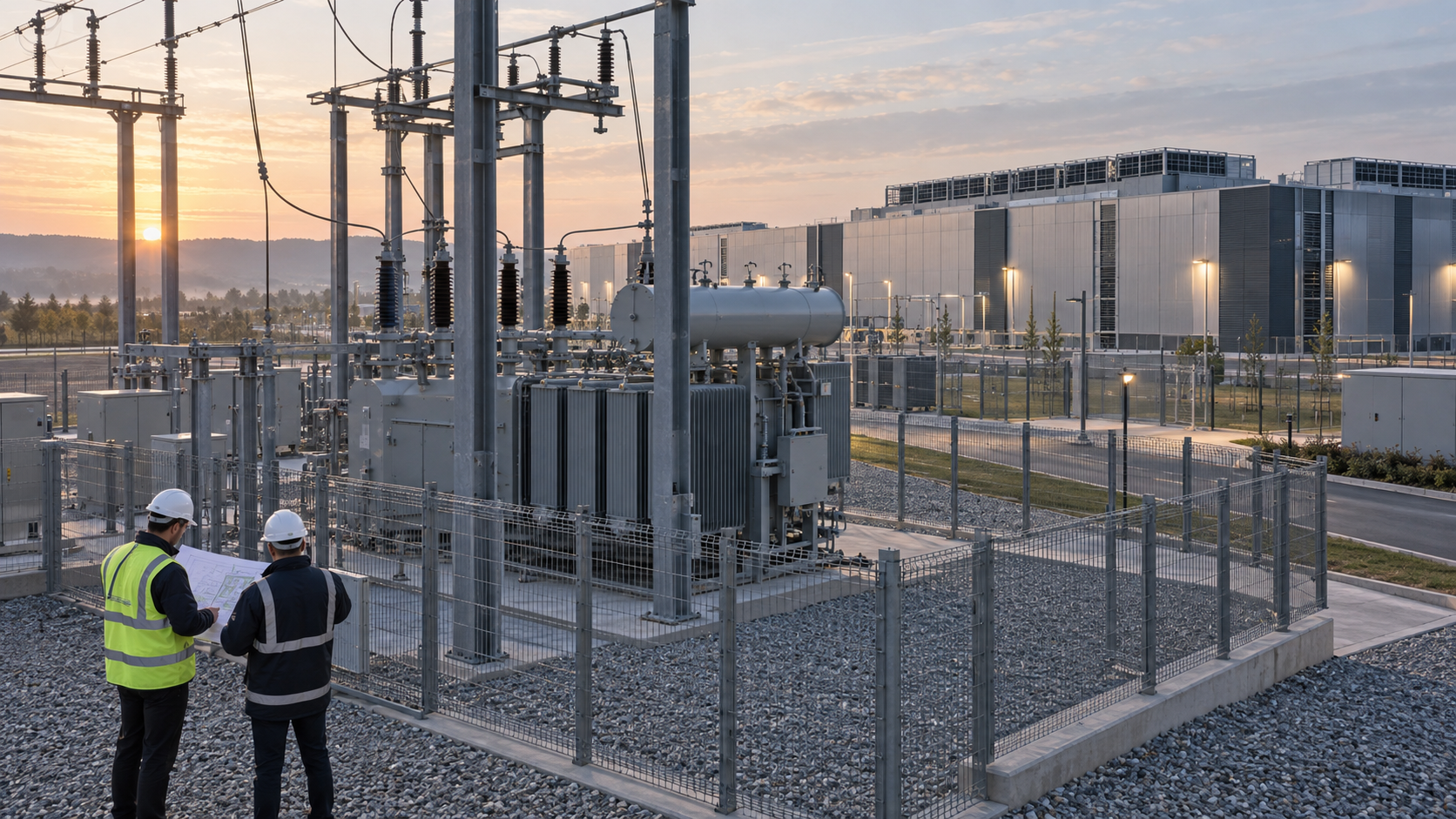
The data-centre market is often discussed through demand: artificial intelligence, cloud migration and the scale of the next development pipeline. The International Energy Agency now projects global data-centre electricity consumption to rise from about 485 TWh in 2025 to 950 TWh in 2030. Yet the same analysis identifies grid connections, transformers, planning systems and capital as constraints on how quickly announced capacity can become operating infrastructure.
For an investor, lender or corporate occupier, that distinction is fundamental. Land may be controlled. Planning may look achievable. A connection request may quote a large capacity. None of those facts, alone, establishes when firm power will be available, what must be built to deliver it, who bears the cost, or how quickly customers will absorb it.
Capacity reserved is not capacity delivered
Power diligence should separate at least six stages that are too often compressed into one number: the initial request, queue position, an accepted connection offer, completion of network works, physical energisation and reliable operating supply. Each stage has different conditions, costs and failure points.
France illustrates the gap. RTE reported in May 2026 that it had reserved nearly 18 GW for around 80 data-centre projects, up from roughly 5 GW across about 40 projects at the end of 2024. RTE also reported that facilities connected for two to three years were using, on average, only around 20% of requested power, while operators expected ten to fifteen years to reach about 80% of requested consumption.
That is not evidence that projects are weak. It is evidence that the grid clock, the construction clock and the customer-ramp clock are different. A credible underwriting case must model all three rather than treating the connection headline as present-day income capacity.
Seven questions before underwriting the site
1. What is the legal and technical status of the connection? An application, a reservation and an energised supply are not interchangeable. Diligence should identify conditions precedent, deposits, milestones, expiry rights and the consequences of delay or scope change.
2. What physical works sit behind the date? New substations, underground cables, transformers and upstream reinforcement may be required. The relevant question is not simply the stated connection date, but the critical path, procurement exposure and evidence supporting it.
3. How firm is the power and how is resilience achieved? Nominal capacity does not describe curtailment rights, outage exposure or the architecture needed for the target service level. Grid supply, backup generation, storage and redundancy must be tested as one operating system by qualified engineers.
4. How will demand ramp? A powered shell, fitted capacity and contracted customer load are three different things. Underwriting should connect phased capital expenditure to credible leasing or customer deployment assumptions, rather than assuming that every available megawatt produces revenue on day one.
5. Can cooling, water and environmental obligations scale with the load? The European Commission’s reporting framework is increasing transparency around energy and water performance. Cooling design, heat reuse, water availability and reporting obligations should therefore be addressed early, not appended after the power case has been agreed.
6. Are fibre, access and planning aligned? Power does not rescue a site with weak network connectivity, constrained access or an unresolved planning path. RTE’s own fast-track criteria combine available land, local acceptance and proximity to the high-voltage network. The asset is a system, not a parcel with a cable.
7. Who carries the mismatch risk? Acquisition agreements, leases, development contracts and financing documents should allocate network-work cost, delay, capacity shortfall and failure to energise. Long-stop dates, price adjustments, termination rights and phased drawdowns are commercial risk tools, not drafting details.
Power changes the valuation conversation
Conventional real-estate metrics remain useful, but they are incomplete if the route to energisation is uncertain. A headline yield or rent assumption cannot compensate for an untested connection programme, an unfunded substation or a customer ramp that trails debt service.
The better approach is scenario-based. What is the value of the site before connection certainty? What capital must be committed before contracted demand is visible? Which milestones change financeability? What happens if energisation is twelve months late, only part of the capacity is firm, or the first customer takes less power than expected?
These questions do not produce a single universal discount. They produce a more honest bridge between technical facts and transaction economics.
The investment-ready site
A data-centre opportunity becomes investment-ready when the land, power, construction, customer and contract schedules close together. The diligence objective is not to eliminate uncertainty. It is to identify which uncertainty is technical, which is contractual, which is commercial—and who is being paid to carry each one.
CGPH Banque d’affaires supports owners, developers and investors in framing transaction strategy, capital structure and counterparty discussions around that integrated risk picture. Grid, engineering, planning, environmental, water, fibre, legal, tax and valuation conclusions should be provided by appropriately qualified advisers.
Sources
- International Energy Agency — Key Questions on Energy and AI (2026)
- RTE — Les data centers en chiffres clés
- European Commission — Energy performance of data centres
- Commission Delegated Regulation (EU) 2024/1364
This article is for general information only and does not constitute investment, legal, tax, engineering, environmental or valuation advice.